Karma and reincarnation
Karma Isn't Punishment: The Reformative Doctrine Critics Never Engage
Nearly every standard objection to karma attacks a cosmic courtroom my tradition never built; the doctrine I actually defend is a classroom, and specifying it is most of the work of defending it.
 A Philosophical Defence of the Doctrine of Karma
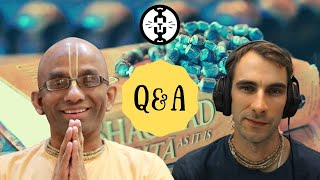 Chaitanya Charan Answers Questions on Skepticism, Karma, Salvation & More
 Jerry ThomasThe Worst Debate I've Had Reviewed
 Karma as Divine Justice
I have spent a lot of hours now debating karma with Christian apologists, and the objections almost never vary. Karma punishes people for deeds they cannot remember. It hands down sentences with no charge sheet. It makes life fatalistic and free will an illusion. It licenses us to walk past people in pain, because they must have earned it. Every one of these lands somewhere. None of them lands on the doctrine my tradition teaches.
That is not a coincidence, and it is not because the objectors are stupid — some of the sharpest people I have hosted on Theology Unleashed press versions of these arguments. It is because "karma" in Western debate usually means a tit-for-tat juridical caricature: a cosmic ledger of offences and payback, administered blindly, forever. Attack that and you win easily. But you have not attacked what A.C. Bhaktivedanta Swami Prabhupada — the founder of the Hare Krishna movement, and the teacher whose account I defend — actually taught. On his account, drawn from the Gaudiya Vaishnava tradition of ancient India, karmic reactions are pedagogy. Each reaction is tailored to reform the specific mentality that produced the action. The aim is not to make you pay. The aim is to change what you want.
Get that distinction on the table and the standard objections do not merely weaken. Most of them dissolve.
Specify before you attack
Here is the minimal core that every serious use of the word shares: our morally significant actions have consequences for us, and the mechanism that delivers those consequences is not governed by ordinary physical laws. The good and bad things life throws at us are earned, by actions in this life or previous ones. That much is common property across the Indian traditions.
Beyond the core, versions differ enormously, and some of the conceptions in circulation are little more than straw men built by opponents so there would be something to knock down. So before defending karma I have to say which karma. The account I am defending is Prabhupada's, as taught in the Gaudiya Vaishnava lineage, and I lean throughout on Akshay Gupta's doctoral work at Cambridge, which gives the doctrine its most careful recent philosophical treatment.
The first thing to notice is how modest the claim is. When I laid this out in my video series on karma, I put it this way: "All karma is saying is that our choices have consequences, and that the things life throws at us which are outside of our control are the consequences for past actions." [^1]
Note the scope. Karma governs what life throws at you — the hand you are dealt. It says nothing about how you play it. Your responses, your effort, your decision to aim at good goals and work for them: none of that is dictated by past karma. We all have a rough intuitive sense of how much agency we have in our own lives, and this doctrine does not quarrel with that intuition at all. It claims far less of your daily life than critics assume.
The second thing to notice is that karma is not offered as the only reason anything ever happens. God can tailor a situation to a particular soul's need for growth quite outside the karmic ledger — a point that matters enormously when we come to victim-blaming, because on this view you can never look at a sufferer and validly infer a past crime. More on that below.
Karma as expanded causality
A sceptic's first instinct is to file karma under superstition. I think that gets the epistemic situation backwards, and the best statement of why came from Chaitanya Charan Das, an ISKCON monk I hosted for a question-and-answer session on the channel.
His argument runs like this. Science is, at bottom, the mathematics of cause and effect; the entire enterprise assumes that events have causes and that like causes produce like effects. But hold that principle steady and look at the moral texture of human life: conscientious, responsible people meet disaster, and the vicious flourish into old age. Faced with that anomaly, the modern move is to shrug and say "chance." And as he put it: "Chance is an admission of ignorance. It is not a proclamation of a causal principle." [^2]
Karma refuses the shrug. It widens the causal frame across lifetimes instead of abandoning causality at the boundary of a single one — and Chaitanya Charan's analogy here is the history of physics itself: when observation outran Newton, physicists did not abandon causality — they widened the frame, and Newton's mechanics became a special case within relativity. Karma proposes the same manoeuvre for the moral anomalies of a single lifetime. You may think the proposal fails. But it is a proposal to extend the causal reasoning science already runs on, not to suspend it.
The free-will objection refutes itself
The objection I hear most often from Christian interlocutors is that karma is fatalism: if my life is determined by past karma, my choices are illusory, and a doctrine that destroys free will destroys moral responsibility with it.
I have a lot of sympathy for the concern and almost none for the argument, because it comes apart the moment you state both halves. Free will, in the sense the objector cares about, is the idea that our choices are really ours and really matter — that they have consequences. And karma is nothing other than the claim that they do. As I put it in the series: "Free will is the idea that our choices have consequences, and karma describes a cosmic mechanism for dishing out these consequences." [^1]
An objection to karma from free will is very nearly an objection to consequences from choice. The doctrine presupposes free will at every step: no freely chosen action, no karmic reaction. What the objector has actually noticed is that karma constrains circumstances — and so it does. You did not choose your parents, your body, your era, or the disasters and windfalls that arrive unbidden. But no worldview on offer lets you choose those things. The Christian has them assigned by providence; the naturalist by genetic and circumstantial lottery. Karma is the only one of the three on which your circumstances are connected to you — to what you have done and what you need next. It is a strange fatalism that gives your past choices more power over your life, not less.
Cosmic sensitivity training: samskaras and the thief
The doctrine earns its keep in the mechanism of reform, and stating the mechanism needs one piece of Vedic psychology.
The Sanskrit term is samskara: a subtle impression left on the mind by experience. Anyone who has studied yoga seriously will have met the word. Impressions differ in depth; the deep ones — call the accumulated pattern a mentality — are carried by the soul from lifetime to lifetime. When I act, the action flows from the mentality I have at the time. And here is the doctrine's central claim: the karmic reaction that an action earns is designed to reform the very mentality that caused it.
Take a thief. The reaction for stealing is to be stolen from — not because the universe is keeping score and owes him one, but because experiencing theft from the receiving end is precisely the experience that dissolves a stealing mentality. He learns, in his own losses, what he was inflicting; compassion for victims of theft becomes possible for him for the first time. Dr Howard Resnick calls the whole arrangement "cosmic sensitivity training," and I have never found a better phrase for it. Whatever you put out into the world comes back — good actions meet encouragement, bad ones meet discouragement — and the return is matched to the mentality, not just to the deed.
But even "reforming the mentality" undersells what the system is finally for. As I said in the series: "The purpose of karma isn't to shape our mentality, it's to shape our desires. It's to make us give up our bad desires and switch to good desires." [^1] Behaviour is downstream. A man who no longer steals but still burns to possess what belongs to others has not finished the lesson; the curriculum runs all the way down to what he wants.
One consequence of the reformative framing needs saying plainly, because it answers the most morally serious objection in the neighbourhood. If reactions were desert — if suffering proved guilt — then compassion might seem like interference with justice, and karma would license exactly the victim-blaming its critics allege. But the tradition itself blocks the move twice over. First, as above, not all suffering is karmic; God may be teaching or showcasing a soul for purposes we cannot see, so the inference from suffering to guilt simply is not available. Second, the Vedic concept of dharma — duty, the moral law governing my own conduct — assigns the administration of karma to God, not to me. As I put it: "Karma is someone else's responsibility, not mine, so enforcing it by not acting out of compassion is a violation of dharma. And when it comes to victims, our duty is many things, but it's never blaming." [^1]
A school, not a courtroom
The clearest test of the two readings — juridical versus reformative — came in a two-on-two debate I fought over reincarnation against the Indian Christian apologists Jerry Thomas and Praveen Kumar, which I later reviewed on the channel. Praveen argued that the birthmark data from past-life memory research actually contradicts Hindu scripture: the Gita and the Puranas say karma determines the next body, he said, so bodies marked by the trauma of a previous death — wounds, not deserts — are evidence against the Vaishnava model.
The argument only works if karma is a sentencing algorithm, mapping crimes to bodily outcomes. It is not, and I said so at the time: "Karma is not supposed to be a system of reward and punishment that makes everyone get what they deserve. What it is supposed to be is a system where souls are given the experiences they need to learn and grow." [^3]
Once you read karma as a school, the supposedly awkward data fits without strain. The Bhagavad Gita — at 8.6 — teaches that whatever state of being one remembers at the moment of leaving the body, that state one attains without fail. Consciousness at death shapes the next embodiment. A traumatic death that stamps itself onto the next body is not a violation of karmic law; it is an instance of the very mechanism the Gita describes, the continuity of consciousness doing exactly what the tradition says it does. The courtroom reading generates the contradiction. The classroom reading predicts the data.
And notice what the school framing does to the fairness objections I listed at the outset. Unfair to punish a man for deeds he cannot remember — but a fitting lesson does not require memory of the original offence, only the persistence of the mentality that produced it, and the mentality is exactly what the soul carries forward. Arguably the forgetting is a mercy: wrongdoing already disturbs the mind, and dragging every past crime into present memory would perpetuate the disturbance, not heal it. No charge sheet — but a curriculum does not owe you an indictment; it owes you the next lesson, and the lesson is self-disclosing in a way a sentence is not: the experience itself is the information. Each objection assumes the courtroom. Take the courtroom away and there is nothing left for them to grip.
When suffering seems to teach nothing
Now the strongest objection, and it is not one of the courtroom confusions. It is empirical. If karma is a reform mechanism, reform should be visible. It often is not. People suffer for decades and learn nothing; some double down on cruelty to the grave. A pedagogy whose pupils observably fail to improve looks like a theory that no evidence could touch — and a reform mechanism that never visibly reforms is doing no explanatory work at all.
I take this seriously, and the tradition has two things to say that are better than the objection expects.
The first is counterintuitive: sometimes the reaction for an action is more of the mentality behind it. Intensification can be the cure. The homely example I used in the series is the child given a whole bag of lollies, whose sugar addiction broke only after she gorged herself sick. Going further down the rabbit hole can exhaust a desire in a way that rationing it never would. So a man who appears to be doubling down may be mid-treatment rather than untreated — the desire being burned through rather than starved. On this view some of the apparent failures of the school are the school.
The second is about timescale, and here the tradition asks for patience the sceptic is entitled to find frustrating. The soul has many lifetimes to get this right, and transformation can accumulate invisibly before it shows. The image I keep coming back to is the Morandi Bridge in Italy, which collapsed in 2018 and killed 43 people. The corrosion in its steel cables had been advancing for decades; to every eye the bridge stood as solid on the last morning as on the first. The collapse was sudden. The cause was not. Character can corrode — and mend — the same way, with the visible break arriving long after the invisible work. The English idiom about the straw and the camel's back gestures at the same truth: a hundred lessons that seemed to bounce off were each doing something.
Let me concede what must be conceded. A mechanism whose effects can hide across lifetimes is, to that extent, shielded from observation, and I will not pretend the multi-lifetime timescale is anything other than a limit on testability. The honest statement is that the reformative reading makes karma coherent and morally serious, not that it makes karma verifiable within one biography. Where the doctrine does touch evidence is elsewhere — in the past-life memory cases, the birthmark data, the deathbed-consciousness claims — and I take that material up in its own articles on this site rather than smuggling it in here. What the objection cannot say is that the doctrine predicts visible reform and fails; the doctrine never predicted that. As I admitted in the series, with myself included in the indictment: "The unfortunate reality is that most of us are thick and do not learn from the gentle lessons, and inevitably many of us need to suffer a little bit in order to gain the wisdom and purification we need to advance on our journey." [^1]
What the tradition's own texts say
A critic could accept everything above and still suspect the reformative reading is a modern apologetic retrofit — a softening invented under Western moral pressure rather than anything the tradition itself teaches.
It is not, and the evidence is in the places you would least expect softness: Prabhupada's commentaries on the Srimad Bhagavatam's judgement passages, the very texts a critic would mine for the courtroom picture. Commenting on Bhagavatam 6.1.68, Prabhupada writes that "punishment by Yamarāja [the god of death] is a process of purification for the most abominable sinful persons." On 5.26.6 — a passage describing the hellish planets, as unpromising a site for pedagogy as the canon offers — he states that Yamaraja punishes souls in order to "bring them back to Kṛṣṇa consciousness." And on 1.7.5 he explains that suffering is aimed at the "reformation of the conditioned soul."
Purification. Return. Reformation. That is the vocabulary of a hospital and a school, not a gallows — and it appears precisely where the retributive reading should be strongest, in the commentary on the god of death himself. The reformative account is not my gloss on the tradition. It is the tradition's gloss on its own hardest texts.
Divine justice, shared ground
I will end with a moment from a dialogue with a Christian that I released as a short clip, because it shows how this doctrine looks once the caricature is out of the way. We had been talking about justice under God's rule — the claim that under God there is perfect justice, human justice being one level and divine justice another, with karma as the mechanism that makes the divine level intelligible. My Christian interlocutor, notably, did not treat karma as an alien horror. He said: "Karma essentially captures the understanding that the universe as God has set it up and as God operates it is fundamentally just." [^4]
He is right, and the concession matters more than he perhaps realised. Christians already believe that the universe is morally governed — that what a man sows, he reaps, and that God's governance of outcomes is neither weak, nor gratuitously cruel, nor capricious. Karma is a specification of how such governance could work: lawfully, particularly, and with reform rather than retribution as its aim, each soul given the experiences its own history shows it needs. You can reject that specification. But then the anomalies return to your own account — the virtuous crushed, the vicious flourishing, the wildly unequal distribution of suffering across newborns — and you must explain them with fewer resources, not more. The critics have spent a generation prosecuting a courtroom that does not exist. The classroom is still waiting for its first serious objection.
[^1]: A Philosophical Defence of the Doctrine of Karma (solo episode), 00:00:00 — https://www.youtube.com/watch?v=5fUehZ8ZRlw&t=0 [^2]: Chaitanya Charan Answers Questions on Skepticism, Karma, Salvation & More (with Chaitanya Charan Das), 00:44:10 — https://www.youtube.com/watch?v=jqs9vYnNeDo&t=2650 [^3]: The Worst Debate I've Had – Reviewed (solo debate review), 00:22:17 — https://www.youtube.com/watch?v=tbKYh2Mn4jE&t=1337 [^4]: Karma as Divine Justice (dialogue clip), 00:00:36 — https://www.youtube.com/watch?v=SC6MFPOctNM&t=36
Comments
Comments are coming soon.